23 Oct, 2025
AI-Powered Chatbot for Student Support: My DSE FAQ Project
Introduction
Ever spent hours hunting for answers about DSE MBA admissions or waitlist movements? PDFs, emails, and multiple websites can make the process painfully slow for applicants. I asked myself: Can AI make this smarter and faster?
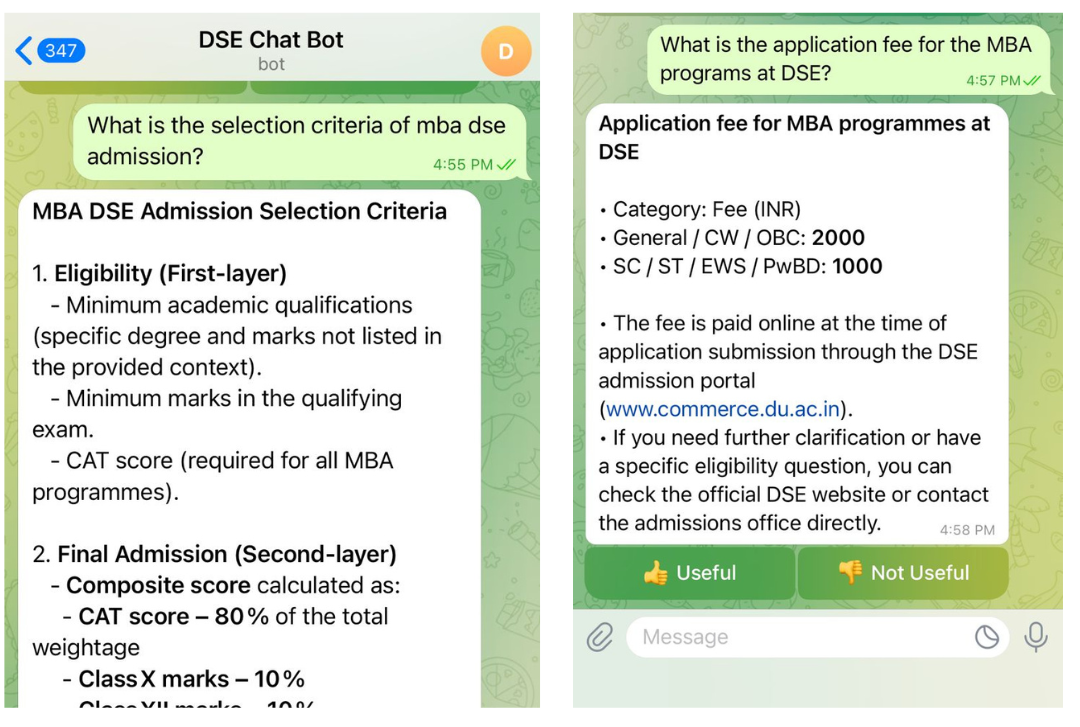
That question led me to build the DSE FAQ Chatbot — an AI assistant that provides instant, accurate answers to 150+ student queries directly on Telegram, powered entirely on free-tier infrastructure.
Project Overview
The chatbot combines Large Language Models (LLM) with RAG (Retrieval-Augmented Generation), leveraging Python, FAISS, Hugging Face Datasets, and Render for deployment. It’s designed not just to answer, but to think, learn, and improve over time.
The project goal was clear: build an AI assistant that is accurate, fast, and cost-effective, while maintaining structured logs for analysis.
`
How the Chatbot Thinks: Behind the Scenes
1. Understanding Queries
When a student types something like:
“Hey, what’s the MBA (BA) cut-off?”
The bot first splits the query:
“Hey” → conversational
“What’s the MBA (BA) cut-off?” → factual
This ensures the bot doesn’t get distracted by small talk — just like humans filter noise before answering.
2. Session Memory
Each chat gets a session ID, functioning like a notebook for the conversation.
Previous questions are remembered.
Follow-ups like “What about HRD?” are understood in context.
Session data is stored in Render-hosted PostgreSQL — no local files, no lost data.
3. Analysis & Reasoning
For every factual query, the bot:
Formats the question for clarity.
Checks its cache — if answered before, it responds instantly.
Uses LLM reasoning if no cached answer exists.
Evaluates confidence — if below 70%, it retrieves context from the indexed 150+ FAQs using FAISS.
This is RAG in action — a fact-checking layer that ensures accuracy and contextual relevance.
4. Logging & Feedback Loop
Every interaction is logged with:
User query
Bot response
Confidence score
Response time
Feedback is collected through a dedicated API endpoint. These logs form the foundation for continuous improvement, allowing me to measure:
Accuracy
Latency
User satisfaction
5. Free-Tier Engineering
Building this AI assistant on $0 infrastructure was a challenge.
FastAPI handles queries and feedback.
Render hosts the backend and database.
FAISS provides semantic search over FAQs.
Hugging Face Datasets store static content efficiently.
Optimizations like warm caching, async API calls, and token management ensured fast, reliable responses despite free-tier limits.
Challenges & Learnings
Accuracy & Coverage: Prompt engineering + dataset updates improved answer quality.
Latency: Free-tier sleeping servers were handled with caching tricks.
Session Coherence: Building conversational context improved user experience.
Budget Constraints: Demonstrated that meaningful AI can run on minimal costs.
Biggest takeaway? AI is not just coding. It’s about designing systems, thinking like an analyst, and iterating quickly.
The Impact
The chatbot:
Answers 150+ FAQs instantly on Telegram.
Stores every interaction for data-driven improvement.
Operates completely free, showing that resourceful engineering and smart design can overcome constraints.
Future Plans
Update RAG with recent waitlists, admission notices, and placement reports.
Integrate user feedback analytics to track friendliness and accuracy.
Build an admin dashboard to monitor response speed, coverage, and usage trends.
Extend coverage to more courses and departments, supporting more students.
Technical Stack
Backend: Python + FastAPI
RAG Index: FAISS
Database: PostgreSQL (Render-hosted)
LLM: OpenAI / Fireworks GPT-OSS-20B
Data Management: Hugging Face Datasets
Frontend: Telegram Bot API
Conclusion
This project was more than a chatbot. It was a lesson in applied analytics, AI engineering, and resourceful problem-solving. Every log, feedback, and confidence score is a step toward making the system smarter — and helping students faster.
🔗Telegram Bot https://telegram.me/DSE_Chat_bot
💻 GitHub Repository (Code & Notebooks): Telegram Bot Repo
💻 GitHub Repository (Code & Notebooks): LLM API Repo